
Walk into a pub in Hamilton and the pokie in the corner is legally required to tell you things. Its return to player, to two decimal places. The odds of its five best and five worst winning combinations. How fast it can take your money. And a permanent notice stating that the maximum you can win on a single game play is 500 dollars.
Open a pokie on your phone in the same room and none of that is required, the maximum win is advertised as 25,000 times your stake, and the return depends on which configuration the operator chose to install. Same person, same town, same afternoon, two completely different disclosure regimes. That gap is what this page is about. Last checked 25 September 2026.
What a New Zealand pub pokie must tell you
These come from the Gambling Act (Class 4 Gambling Equipment) Minimum Standard, the technical standard the Department of Internal Affairs applies to every gaming machine in a pub or club.
| Requirement | Detail |
|---|---|
| Maximum win notice | Permanently displayed: maximum accumulated win per game play, including all wins from primary, feature and bonus games, stand alone progressive prize and gamble option, is 500 dollars |
| Return to player | The average winnings paid to players must be displayed as the approved RTP percentage, to a minimum accuracy of two decimal places |
| Lowest figure wins | Where a game has different RTPs for different bet values, the lowest must be the one displayed |
| Both figures for features | Where a bonus feature has one RTP in one mode and another in a second, and the difference is more than 0.25 percent, both must be displayed |
| Odds of winning | The five highest and five lowest winning combinations, with the theoretical average number of games for any win |
| Spend rate | The maximum and minimum player spend rate for the game |
| Jackpot split | For linked jackpot games, the total RTP separated into the game’s contribution and the jackpot’s |
Read the third row again, because it is the interesting one. New Zealand already anticipated the problem of a game shipping in several return configurations, and its answer was to require the least favourable number to be the one on the screen.
What an online pokie must tell you
Nothing, today. No online casino holds a New Zealand licence, so none of the above applies to a game you open on a phone. There is no cap on a single win, no required disclosure of spend rate, and no rule forcing the lowest configuration to be shown.
Established studios do publish a return to player figure inside the game, and reputable operators display it. But the figure that applies to you is the one in that casino’s own game information screen, because, as we set out on game providers, studios ship the same title in several configurations and the operator picks which to run. Two casinos, identical artwork, identical mechanics, different return.
This changes with licensing. Licensed operators will be bound by the Online Casino Gambling Regulations 2026, including a prohibition on autoplay, mandatory player limits and a ban on credit. Until then those rules bind nobody serving New Zealand. The timeline is on New Zealand online casino law.
The lobby, and what is actually in it
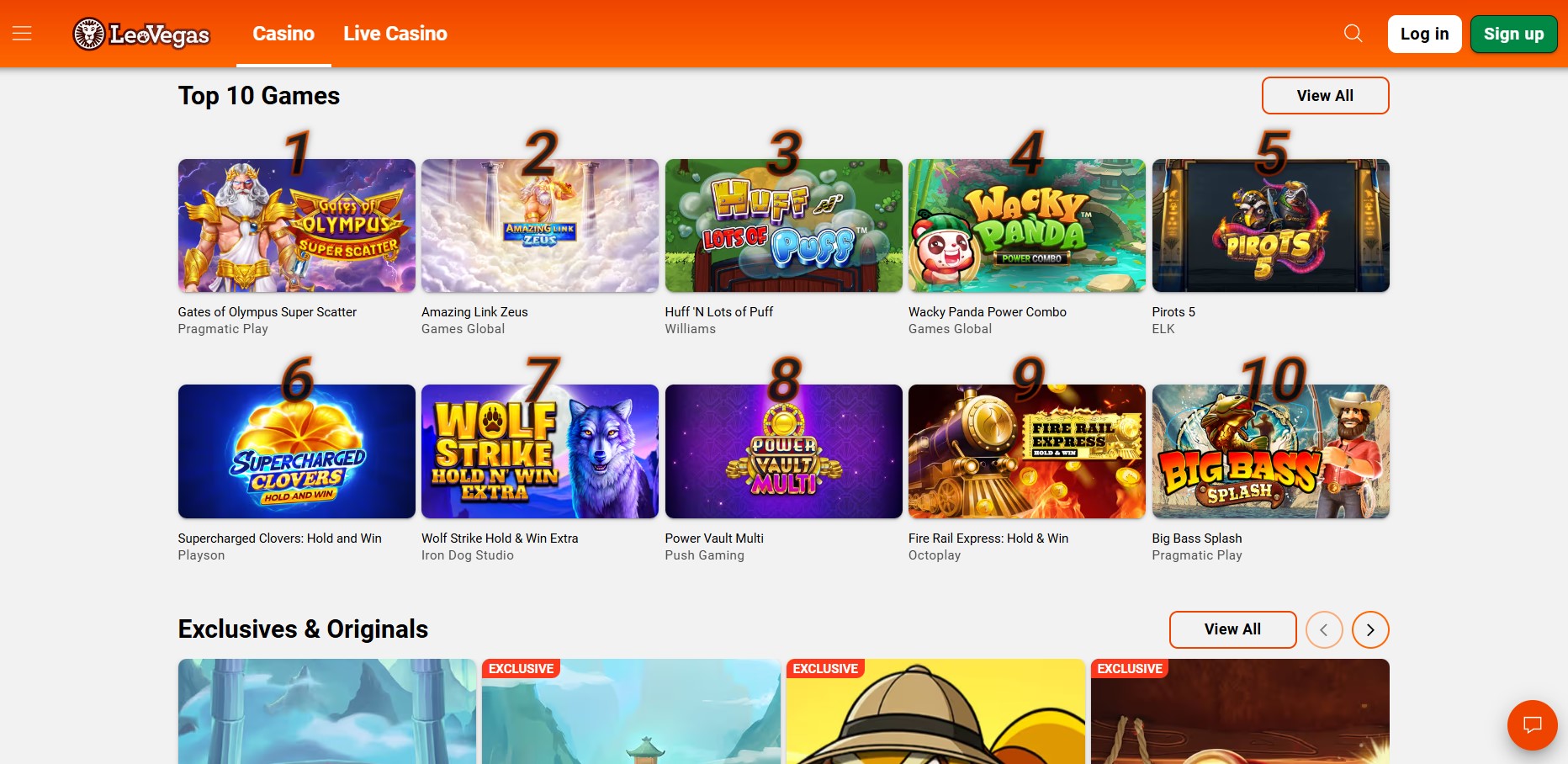
| Rank | Title | Studio |
|---|---|---|
| 1 | Gates of Olympus Super Scatter | Pragmatic Play |
| 2 | Amazing Link Zeus | Games Global |
| 3 | Huff N Lots of Puff | Williams |
| 4 | Wacky Panda Power Combo | Games Global |
| 5 | Pirots 5 | ELK |
| 6 | Supercharged Clovers: Hold and Win | Playson |
| 7 | Wolf Strike Hold and Win Extra | Iron Dog Studio |
| 8 | Power Vault Multi | Push Gaming |
| 9 | Fire Rail Express: Hold and Win | Octoplay |
| 10 | Big Bass Splash | Pragmatic Play |
Two things stand out. Nine studios across ten games, which is the opposite of the live casino lobby, where two companies supply nearly everything. And three of the ten are hold and win games, the mechanic that has quietly taken over the category.
Hold and win, and why it is everywhere
The classic pokie paid its big money through free spins. Hold and win works differently: landing enough special symbols triggers a respin round in which those symbols lock in place and you get three chances to add another. Each new symbol resets the counter to three.

Mathematically it is just another way to package the same return. Psychologically it is not. The board fills slowly, the counter ticks down in front of you, and the round is a sequence of near misses by construction. There is nothing dishonest in it, but it is worth knowing that the format is engineered to produce the feeling of almost getting there, repeatedly, and that the feeling is not information about what comes next.
Reading a pokie honestly
| Number | What it tells you | What it does not |
|---|---|---|
| Return to player | The long run share of stakes returned, over a very large number of spins | Anything about your session. It is an average across millions of spins |
| Volatility | How that return is distributed: small and often, or rare and large | Whether the game is generous. High volatility is not better value |
| Maximum win | The cap, as a multiple of stake | A realistic outcome. A 25,000x cap is the edge of the distribution, not a target |
| Hit frequency | How often any win lands | How large. Most hits on most games return less than the stake |
| Bonus buy price | What the feature costs directly | Better value. It does not improve the return, it accelerates the spend |
The honest version of volatility: a game that can run three hundred spins without paying needs a stake sized for three hundred spins. Most people size the stake for the win they imagined instead, which is how a session ends early.

Exclusives cannot be compared
Most lobbies carry an exclusives or originals shelf, games available at that operator only. They can be perfectly good. They are also impossible to price check, because there is no second operator running the same title at a different configuration, and no independent tracking of them anywhere.
If you like one, fine. Just treat an exclusive as a game you cannot comparison shop, and read its information screen rather than assuming it matches the studio’s public titles.
Pokies or slots
Both mean the same machine. Pokies is the New Zealand and Australian word and is what you will hear here; slots is the international term and is what the studios print on their own marketing. A site that never says pokies was not written for this market, which is a small but reliable signal about who else it was written for.
What to do with all this
- Open the game information screen before the first spin and read the return to player there, not on a comparison table, including ours.
- Match the stake to the volatility, not to the jackpot. High volatility means long dry runs are normal, not a sign anything is wrong.
- Ignore the maximum win figure when choosing. It describes the tail of the distribution and nothing about a typical session.
- Set the deposit limit first. Lowering a limit is instant at most operators, raising it takes 24 hours. Use that asymmetry, as set out on responsible gambling.
- Check the weighting before taking a bonus. Pokies usually count 100 percent, which is the one place a wagering requirement is realistically clearable. See casino bonuses and free spins.
What return to player should I expect from an online pokie?
Commonly between 94 and 97 percent, but the figure that applies is the one in that casino’s own game information screen. Studios ship the same title in several return configurations and the operator chooses which to install, so the same named game can pay differently at two sites.
Is the maximum win on a pub pokie really 500 dollars?
Yes, for Class 4 machines in New Zealand pubs and clubs. The minimum standard requires a permanent notice stating that the maximum accumulated win per game play, including all feature and bonus wins, stand alone progressive prizes and the gamble option, is 500 dollars. Online pokies have no such cap.
Do online pokies have to display their RTP in New Zealand?
Not today. The disclosure rules apply to licensed gambling equipment, and no online casino holds a New Zealand licence yet. Established studios publish a figure inside the game and good operators show it, but it is voluntary rather than required.
Does a higher maximum win mean a better game?
No. Maximum win describes the extreme tail of the outcome distribution. A game with a 25,000x cap and one with a 5,000x cap can have identical returns to player, arranged differently, with the larger cap paying rarer and smaller wins along the way.
Is buying a bonus feature good value?
It does not improve the expected return, it converts a long wait into an immediate purchase. The practical effect is a much faster spend rate. At 100 times the stake on 0.20 NZD spins, one press costs 20 NZD. Bonus funds usually cannot be used to buy features, and doing so can breach the terms.
Why are so many new pokies hold and win games?
Because the format performs. Locking symbols with a resetting three spin counter creates a sequence of near misses inside every bonus round. The maths is no different from any other packaging of the same return, but the experience is more engaging, which is why three of LeoVegas’s top ten on 25 September 2026 used it.

About the author: Matt Donaldson
Editor and casino reviewer, Christchurch
I check the player journey, including the terms, games, support and account controls. A payment result appears as first-hand evidence only when it is in the recorded test.
Each category score is based on what was observed. If a feature was not checked, it is marked Not tested.
Read Matt's profileClear reviews for New Zealand readers, built from recorded observations and updated when the source or market status changes.
- Evidence before adjectives — each claim is tied to an action, source, date, device, amount or operator reply recorded during the review.
- Four categories kept separate — Player Safety & Trust, Games & Usability, Bonuses & Terms, and Banking & Withdrawals are assessed on their own evidence.
- Honest scores — whole points from 1 to 5 only. When a category was not checked directly, it is marked Not tested.
- New Zealand status checked — access, transitional permission, an application and an issued DIA licence are described as different things.
- Updates stay visible — time-sensitive terms and regulatory claims are checked again, and confirmed errors are corrected.
